Wednesday, February 20, 2013

Unit 1 Paper


Part 1. Your Interest in an Aspect of Unit Content

            I have to say that the area in which interests me the most is cellular respiration. I think our bodies are such amazing structures and it is so difficult for me to wrap my mind around the ideas around topics such as this. What I think is so amazing is that our body can take one tiny molecule of glucose, then break it down to pyruvate and continue the process all the way to the ending point of the electron transport chain. I find it even more amazing that from those original glucose molecules, we end up with nearly 36 ATP. How can all of this be happening inside my body all the time! For me, molecules are such a difficult thing to understand. I have never seen them perform their work yet I am amazed by their abilities everyday.
http://www.biology.iupui.edu/biocourses/N100/images/ch9res.jpg          
        Something that I find interesting about the process of learning about cellular respiration is the funny and creative ways that people choose to try and remember all of the steps involved. Some people work well with pictures, such as the one shown here. Where others choose to go to different extremes, such as the teacher who created the YouTube video below to help his students remember the process. 

 
 When I look at these two different sources, I can also see that people have different ideas about the complexity in which they need to know this topic. For example you can just learn the basic steps and the final outcome. By doing this, a person can understand the process and why it happens. However, a person can also dive much deeper into the topic by learning all of the molecules and enzymes involved and at what exact step each is utilized.

            To put it mildly, I find cellular respiration a fascinating topic to learn about. I find it interesting the our bodies can work with the ATP production of either aerobic or anaerobic respiration depending on the situation. I have really learned to love science over the last few years, and it seems to me that the more I learn the more I realize I don’t really know. This may sound a bit silly, but it is true. I can’t wait to learn more so I can discover even more topics that I know nothing about!


Sources

Mr. Hsu, scienceteacherhsu.Cell Respiration" - Cellular Respiration Song. Retrieved February 18,2013. Web. http://www.youtube.com/watch?v=3aZrkdzrd04

Image of cellular respiration. Retrieved February 20, 2013. Web. http://www.biology.iupui.edu/biocourses/N100/images/ch9res.jpg


 Part 2. Thinking About the Course

  1. What one assignment or activity you performed in this unit are you the most proud of?
The one project I performed in this unit that I am most proud of is my written assignment on Autism Spectrum Disorder. This was a topic that I only new a little bit about, and the paper helped me to see a few different perspectives on the issue. What made it even better was that, being a mother, I could relate to the different ideas on the subject. Also, I generally enjoy writing papers because I feel that it pushes me to broaden my horizons on any given subject.
  1. What do you now understand best about the information in this unit?
I feel that I had a great advantage coming into this course, because, thus far, everything we have been learning about I learned in my BIO 181 course last semester. So, in general, I feel that everything we have gone over has been a great review and refresher. I feel that the information we have explored thus far has really helped me to further understand the material, and the textbook puts the ideas into simple terms that make sense.
  1. What actions did you take for yourself to enhance learning or enjoyment of the material?
As I said before, many of the topics we have covered thus far have been review; furthermore, many of the topics are also coinciding with the BIO 201 class I am taking this semester. With this being said, I feel strongly that when I read and review the information for each chapter, it is really helping me to know the material and really understand how things work. I have enjoyed the labs and at every opportunity I try to explain what I am doing to my daughter. Talking about the subject, even if it is in kindergarten terms, has helped me see the material from yet another perspective.
  1. When did you feel most “connected” with the course? Most distanced?
Most of the time I have felt equally connected with the course. The only time I felt disconnected with the course was during the “What Molecules is That” lab. That is one moment where I felt frustrated and a bit like I did not understand the material. I feel that I could have avoided that disconnect if I had started on the project sooner and not waited until the last minute. Aside from that, I have not had a moment where I felt “most connected”. I have enjoyed the material fairly equally and all in all I feel that I have had a pretty good understanding of the material presented.
  1. What could I offer you to help your understanding or enjoyment of the material?
All that I can say for this question is that I think you have done a wonderful job of presenting the material in an easy to understand method. The online learning environment can often be challenging, but I feel that you have given us great information to use in our studies. In fact we may even get a little more. Not only do we have the textbook and lectures, you also have also provided us with great information to utilize from the Internet. Furthermore, you seem to always be available for questions. In fact I do not think I can even count the number of times you have said to call or email if we have questions. All-in-all I feel that this is a great course, and the material has been presented in an easy to use and understand format.


Monday, February 18, 2013

Milk, Juice, Carrots

-->
Answers
Record your answers here, space out as needed, and copy and paste them into your blog. Include three or so photos for each part to illustrate the process of the experiment. Thanks!
Milk: Record your hypothesis, observations, explanation, and factors here.
Hypothesis: I believe that, if the milk is left in a jar in a dark warm place for three days, then it will begin to spoil. I believe that its combination of ingredients will begin to separate.

Observations: The milk that had been sitting for three days had a very thick texture and the color was almost a yellow hue. Although the texture was still pretty smooth, I suspect that it would have become much more clumpy (like cottage cheese) if I had left it there for a longer period of time.

Explanation: When the temperature of the milk was raised, it accelerated the process of spoiling.

Factors: I believe the warm temperature, and the dark environment allowed the change in the consistency of the milk. I had the jar closed, so perhaps the lack of oxygen also assisted to the change.


Juice: Write your observations and explanation here.

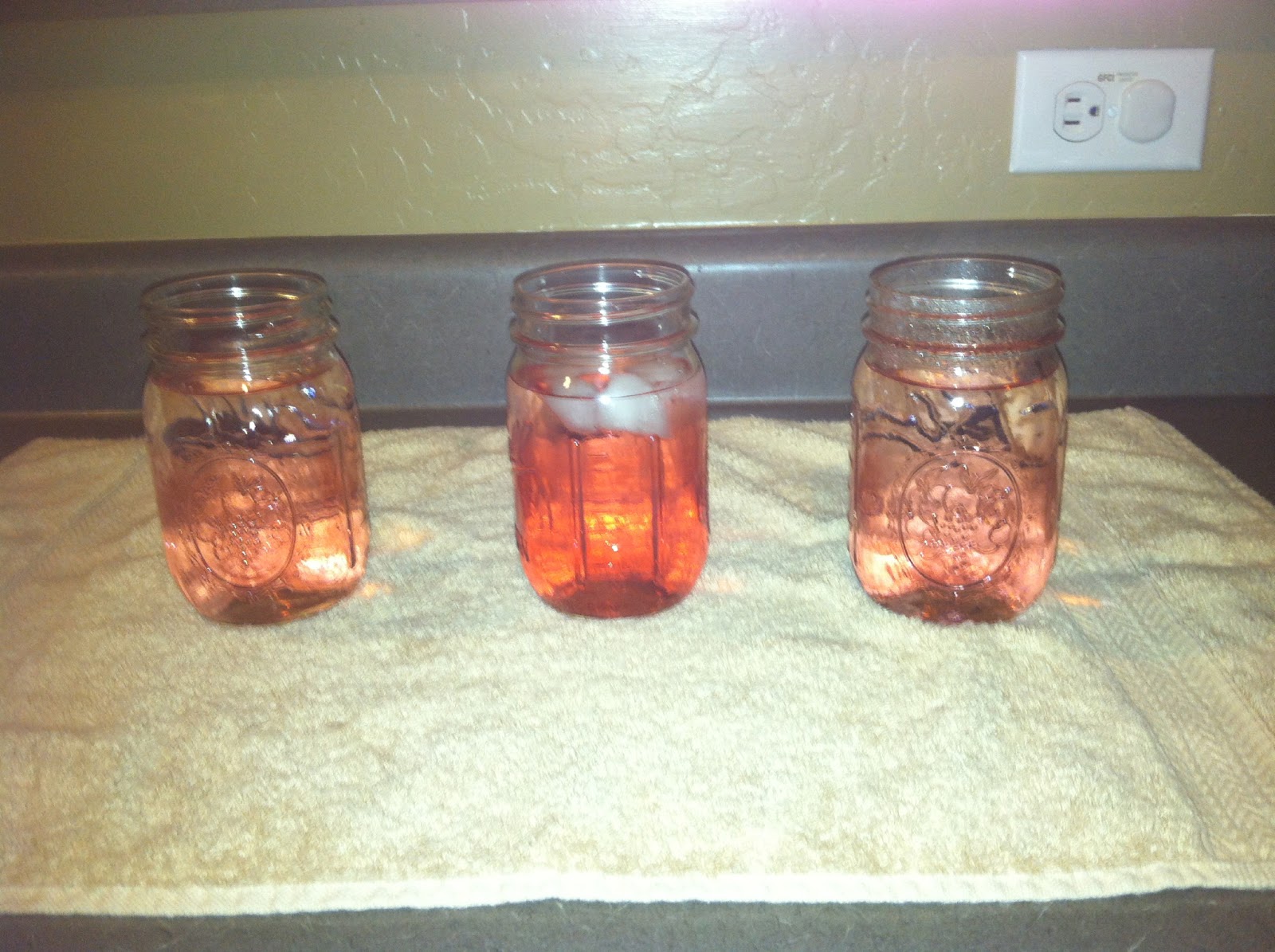
In jar #1 (room temperature water) the juice seemed to quickly diffuse throughout the water. After it had been sitting for a few minutes, the juice seemed to be slightly heavier towards the bottom half of the jar.

In Jar #2 (iced water), when the juice was first poured in, it had sort of a glassy appearance. Again in this jar the juice seemed to diffuse throughout the jar. It seemed to be more evenly dispersed and also the color stayed much darker than in the other two jars. I can assume that the color remained darker because the proteins or molecules in the juice were not raised to a high temperature, which may cause the structure to denature.

In jar #3 (boiling water), when the juice was poured in, it seemed to diffuse very quickly. The color of the juice in the water was just a light red and was not nearly as dark as the ice water.

In my test, Jar 1 and 3 behaved in much the same way.


Carrot:  Record your hypothesis, tightness of string and texture observations and measurements, and what type of water caused shrinkage or expansion here.

Hypothesis: I believe that the carrot in the salt water will expand and I believe that the carrot in the fresh water will stay the same.

Initial length and width of carrot pieces:

Piece 1 – 10.5 cm in length and 2.8cm in diameter (placed in the fresh water)

Piece 2 – 11.6cm in length and 2.3cm in diameter (placed in the salt water.

After-experiment length and width of carrot pieces:

Piece 1 – 10.5 cm in length and  2.8 cm in diameter

Piece 2 – 11.4 cm in length and 2.1cm in diameter

My original hypothesis was half correct. I predicted that the carrot in the fresh water would stay the same. However, I believed that the carrot in the salt water would expand. This was incorrect. The carrot actually shrunk in both length and diameter.
I am now remembering the information from our recent chapter that explained how cells in to much salt will begin to shrick because they are trying to balance the environment.


Sunday, January 27, 2013

Autism Spectrum Disorder and Childhood Vaccines


     There is an issue of growing controversy that has risen amongst parents and the world of scientific research. The issue at hand is weather or not childhood vaccines are a leading cause in autism spectrum disorders (ASD) amongst today’s children. There are people on both ends of this debate that feel very passionate about their views. There has been extensive scientific research that has attempted to find a correlation amongst several different vaccines and the disorder or even certain substances that have are used to make the vaccines. This short essay will attempt to display a few differ sides of this very controversial debate.
     Some people feel that the possibility of their child developing ASD is not a risk they are willing to take. Since around 1990, the incidences of ASD has gone through the roof. There are a few specific chemicals or vaccines that this group is generally concerned with. There is a preservative called thimerosal that was found in many childhood vaccines that supports anti vaccine administration believe could be a cause for ADS. This preservative has currently been all but removed from most vaccines. Another issue that is under investigation is the vaccine for measles, mumps and rubella (MMR). The influenza vaccine is yet another vaccine that supporters of this view feel is a threat. There are support groups, anti-vaccines activists, doctors, and parents that feel the possibility of a child developing ASD is much to great to risk their children being vaccinated. Many supporters of this view are much less concerned with the possibility of their child contracting a disease that these vaccines are created to protect against because the occurrence in the United States is very low.
     Another view is that the risk of a child developing ASD is less likely related to childhood vaccines, and the possibility of a child contracting a life threating disease due to non vaccination is not a risk worth taking. This happens to be where my convictions lye, and I know that there are many parents that feel the same. As a mother of two children (who have received childhood vaccines), I feel that vaccines are a big reason why our country is not plagued with outbreaks of communicable and life threatening diseases regularly. I thankfully have never lived during a time where such life threatening or altering diseases occurred regularly, such as polio in the 1950’s. I also believe that there is a possibility that there is a correlation between childhood vaccines and ASD. Furthermore I believe that it is possible that some childhood vaccine may be the cause of ASD in children with a certain genetic makeup. However, I believe that if parents stop vaccinating their children, the resulting outbreaks will be far worse than the results that develop with ASD. I believe that, even if my child develops ASD, my child will still be living, whereas the result of an outbreak due to lack of immunization may very well take the lives of our children.
     Opposite of the first view, there is substantial research that shows there is no correlation between childhood vaccines and ASD. There are also many reputable supporters of this view including, The Center for Disease Control, The American Academy of Pediatrics, The Autism Science Foundation, and list goes on. For several years there has been millions of dollars spent on the researching the possibility of vaccines or the chemicals in the vaccines as a cause for ASD. All of the research says that there in no correlations. Furthermore, all of the sources above suggest that parents should immunize their children. One of the biggest concerns surrounding the issue of childhood vaccines and vaccinations is the hugely growing numbers of children being diagnosed with ASD. Supports of this view fend of the growing numbers debate with a very convincing case. They say that the growing number of children being diagnosed with ASD is associated with our growing recognition for the signs of the disorder. As we become more familiar with the symptoms, it is more easily diagnosed. Furthermore, for every allegation of causation, supporters of this view have strong scientific research to backup their position.
     There is no doubt that the research of this very controversial issue will continue to be conducted for many years to come. Research on this issue should continue, but perhaps we should not let the research on the correlation and or causation of childhood vaccinations causing ASD cloud other research into the cause. With the growing number of children being diagnosed every year, the focus should be on detecting the early signs and also a broadened set of research into other causes and treatment. This of course is another view that is not shared by everyone.
     There are, of-course, many different views on the correlation between childhood vaccines and Autism Spectrum Disorder. Each of the different viewpoints presents strong arguments for their case. With this being said, I feel that each parent should do their research, ask questions, and become informed on the facts before they make a decision to vaccinate or not. Knowledge is the key to understanding the risks and benefits of any decision. 


References

Adams, Mike. Vaccines Cause Autism: Supporting Evidence. (NaturalNews.com. October 6, 2009) Web. Viewed on January 27, 2013. http://www.naturalnews.com/027178_autism_vaccines.html

American Academy of Pediatric. Facts for Parents About Autism and Vaccine Safety. March 2008.  PDF File. Web. Viewed on January 26, 2013. http://www.google.com/url?sa=t&rct=j&q=&esrc=s&source=web&cd=2&ved=0CEIQFjAB&url=http%3A%2F%2Fwww2.aap.org%2Fadvocacy%2Freleases%2Fautismfactsforparents.pdf&ei=gAMGUdqpEYmiiQLlqoCQCQ&usg=AFQjCNGgBIAt9F2UbX2unqhROeiqD6R7cQ&bvm=bv.41524429,d.cGE 

Autism Science Foundation. Autism and Vaccines. Web. Viewed on January 26, 2013. http://www.autismsciencefoundation.org/autismandvaccines.html

Centers for Disease Control and Prevention. Concerns about Autism. Web. Viewed on January 26, 2013. http://www.cdc.gov/vaccinesafety/concerns/autism/index.html

Johnson, Michael D.. Human Biology: Concepts and Current Issues. Sixth edition. (Pearson Education Inc., 2012) Pages 2-3.

Plotkin, Stanley. Vaccines and Autism: A Tale of Shifting Hypotheses. (Oxford Journals, Clinical Infectious Diseases) Web. Viewed on January 26, 2013. http://cid.oxfordjournals.org/content/48/4/456.full